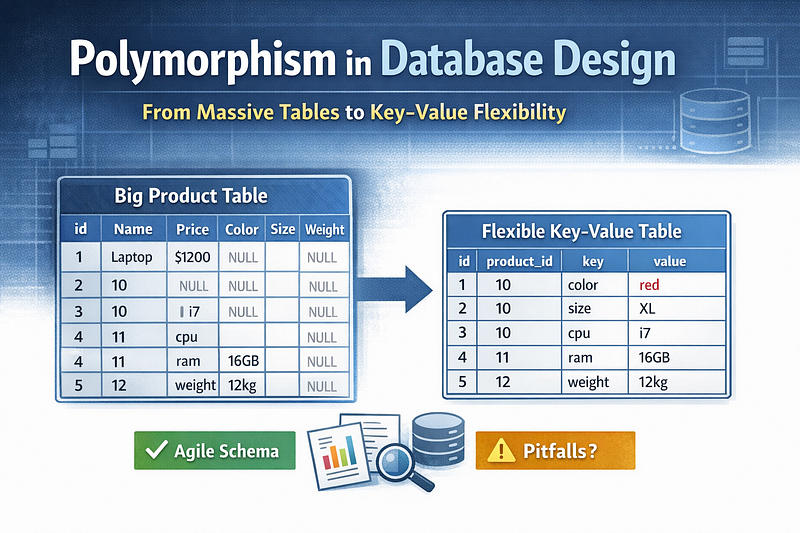
Modern systems evolve fast. New features appear, requirements change, and data models grow in unexpected directions. If you’ve ever worked with a “god table” — a huge table with dozens or hundreds of columns — you know how painful schema evolution can be:
- every new feature requires a migration
- many columns stay empty for most rows
- the table becomes harder to maintain
- the schema no longer reflects real business logic
One way to avoid this is to use polymorphism in the database through a key–value (EAV) table. Instead of adding new columns, you store flexible attributes as rows.
This article explains how this pattern works, when it’s useful, and where it can go wrong — with a simple example you can study and experiment with.
🔍 What Problem Does This Solve?
Imagine you have a table products:
id | name | price | color | size | weight | material | warranty | …
As the business grows, new product types appear:
- electronics
- clothes
- furniture
- digital goods
Each type needs different attributes. You end up adding more and more columns:
screen_sizecpuramfabric_typedimensionsdownload_urllicense_key
Most of these columns are NULL for most rows. Migrations become constant. The schema becomes a mess.
The Polymorphic Key–Value Solution
Instead of adding new columns, we store attributes in a simple, flexible table:
product_attributes
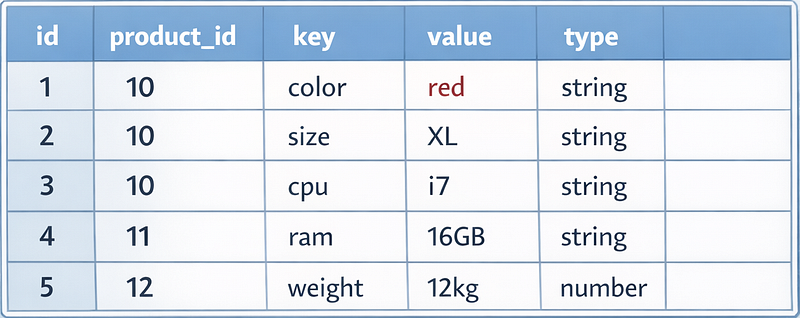
SQL schema:
CREATE TABLE product_attributes (
    id SERIAL PRIMARY KEY,
    product_id INTEGER NOT NULL,
    key VARCHAR(100) NOT NULL,
    value TEXT NOT NULL,
    type VARCHAR(20) NOT NULL, -- string, number, boolean, json
    created_at TIMESTAMP DEFAULT NOW()
);
Now you can store any attribute without touching the schema.
Simple Example: Storing Dynamic Product Data
Insert attributes for a T‑shirt:
INSERT INTO product_attributes (product_id, key, value, type)
VALUES
(10, 'color', 'red', 'string'),
(10, 'size', 'XL', 'string'),
(10, 'material', 'cotton', 'string');
Insert attributes for a laptop:
INSERT INTO product_attributes (product_id, key, value, type)
VALUES
(11, 'cpu', 'i7', 'string'),
(11, 'ram', '16GB', 'string'),
(11, 'screen_size', '15.6', 'number');
Query: Get all attributes for a product
SELECT key, value
FROM product_attributes
WHERE product_id = 11;
Query: Find all products with a specific attribute
SELECT product_id
FROM product_attributes
WHERE key = 'color' AND value = 'red';
This is the essence of polymorphism: one table, many types of data, no schema changes.
Benefits of This Approach
1. No more schema migrations
New attributes = new rows, not new columns.
This is extremely useful when:
- requirements change often
- product types vary
- you don’t control the schema (SaaS, plugins, integrations)
2. Flexible and future‑proof
You can add attributes dynamically:
- from admin panels
- from configuration
- from user input
- from external systems
No DBA involvement needed.
3. Works well for sparse data
If only 5% of products have a screen_size, why create a column for everyone?
4. Great for prototyping
You can start fast without designing a perfect schema.
5. Easy to extend with JSON
You can store complex values:
INSERT INTO product_attributes (product_id, key, value, type)
VALUES (12, 'dimensions', '{"w": 100, "h": 50}', 'json');
Pitfalls and How to Avoid Them
This pattern is powerful — but dangerous if misused.
1. Harder to query
Filtering becomes more complex:
SELECT p.id
FROM products p
JOIN product_attributes a1 ON a1.product_id = p.id AND a1.key = 'color' AND a1.value = 'red'
JOIN product_attributes a2 ON a2.product_id = p.id AND a2.key = 'size' AND a2.value = 'XL';
Solution: Use materialized views or caching for common queries.
2. No strong typing
Everything is stored as text unless you enforce types manually.
Solution: Use a type column and validate in the application layer.
3. Harder to enforce constraints
You can’t easily enforce:
- required attributes
- allowed values
- foreign keys
Solution: Use application‑level validation or attribute metadata tables.
4. Performance issues at scale
A product with 50 attributes = 50 rows. A million products = 50 million rows.
Solution:
- add indexes on
(product_id)and(key, value) - shard by product type
- use caching (Redis)
5. Overuse leads to chaos
If everything becomes key–value, you lose structure.
Solution: Use this pattern only for dynamic or optional attributes. Keep core fields in the main table.
When Should You Use This Pattern?
Good use cases:
- product catalogs
- CMS metadata
- user preferences
- feature flags
- IoT sensor data
- audit logs
- dynamic forms
Bad use cases:
- financial transactions
- core business entities
- data requiring strict validation
- heavy analytical workloads
Final Thoughts
Polymorphism in database design — especially through a key–value table — is a powerful tool for building flexible, evolving systems. It helps avoid schema bloat, reduces migration overhead, and supports dynamic data models.
But like any abstraction, it must be used intentionally.
Use it for dynamic, optional, or unpredictable attributes. Avoid it for core, validated, business‑critical data.
If you balance flexibility with structure, this pattern becomes a reliable foundation for scalable, maintainable systems — especially in fast‑moving domains like e‑commerce, gaming, SaaS, and content platforms.