You’ve dealt with threads in production. You’ve seen the race conditions, the deadlocks, the “works on my machine” moments. This is a casual, example-first refresher — not a textbook.
What even is a Thread?
A thread is the smallest unit of execution. Your JVM always has at least one — the main thread. Every thread has its own call stack, but they share heap memory, which is exactly why concurrency is both powerful and terrifying.
“Two threads walk into a bar. The bartender asks who’s first. Neither knows.”
There are two classic ways to create a thread. Extend Thread, or implement Runnable. In practice you’ll almost always use Runnable — or better yet, a lambda.
Creating threads
// Option A: extend Thread (old school, limits inheritance)
class MyThread extends Thread {
    public void run() {
        System.out.println("I'm running on: "
            + Thread.currentThread().getName());
    }
}

// Option B: Runnable (preferred - separates task from thread)
Runnable task = () -> System.out.println("Hello from a lambda thread!");
Thread t = new Thread(task, "my-worker");
t.start();   // spawns a new OS thread - DON'T call run() directly!
             // calling run() just executes it on the current thread
Thread lifecycle
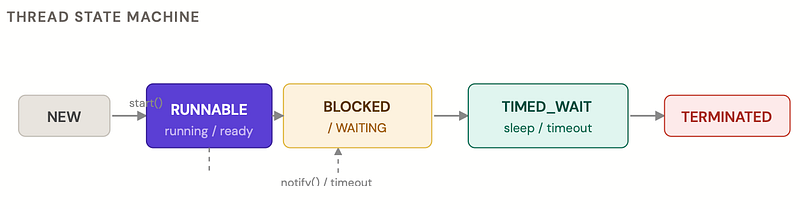
A thread goes through these states. It’s not always a straight line — it can bounce between BLOCKED, WAITING, and RUNNABLE while alive.
Stopping a thread & join()
Java deprecated Thread.stop() long ago because it left objects in broken states. The right way is to use an interrupt flag and check it cooperatively inside your loop.
Stopping a thread gracefully + join()
Thread worker = new Thread(() -> {
    while (!Thread.currentThread().isInterrupted()) {
        doSomeWork();
    }
    System.out.println("Thread stopping cleanly");
});

worker.start();
Thread.sleep(2000); // let it run 2 seconds
worker.interrupt(); // sets the interrupt flag - the thread will see it
worker.join();      // current thread blocks until worker is TERMINATED
worker.join(5000); // or with a 5s timeout - safer
System.out.println("Worker is done, continuing...");

// If your thread sleeps, InterruptedException is thrown when interrupted
Runnable sleeper = () -> {
    try {
        Thread.sleep(10_000);
    } catch (InterruptedException e) {
        Thread.currentThread().interrupt(); // re-set the flag!
        System.out.println("Woken up early, cleaning up");
    }
};
CLASSIC MISTAKE
When catching
InterruptedException, always callThread.currentThread().interrupt()afterward. Catching the exception clears the interrupt flag — if you don’t re-set it, the rest of the call stack will never know the thread was interrupted.
Synchronization, monitors, wait & notify
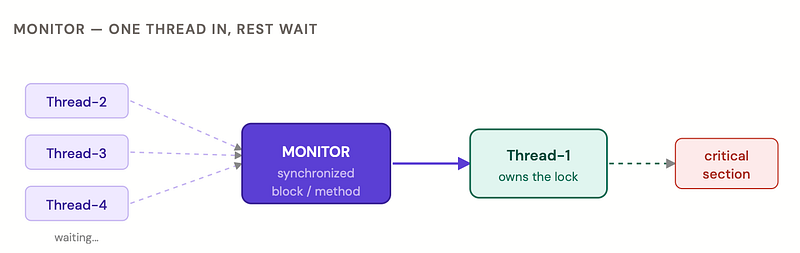
Every Java object has a built-in monitor (also called an intrinsic lock). When you mark a method or block as synchronized, only one thread can hold that lock at a time. Everyone else queues up.
class BankAccount {
    private double balance = 1000.0;
    // synchronized method - lock is the BankAccount instance

    public synchronized void withdraw(double amount) {
        if (amount > balance) throw new IllegalStateException("Insufficient funds");
        balance -= amount;
    }

    // synchronized block - more fine-grained, shorter lock duration
    public void deposit(double amount) {
        doSomeNonCriticalWork(); // runs without lock
        synchronized (this) {
            balance += amount;  // only this part is protected
        }
    }
}
wait(), notify(), notifyAll()
These methods let threads communicate through a shared object. wait() releases the lock and puts the thread to sleep. notify() wakes one waiting thread. notifyAll() wakes them all. Classic producer-consumer:
Producer-Consumer with wait/notify
class MessageBus {
    private String message;
    private boolean hasMessage = false;

    public synchronized void produce(String msg) throws InterruptedException {
        while (hasMessage) {
            wait(); // buffer full - release lock and sleep
        }
        message = msg;
        hasMessage = true;
        notifyAll(); // wake up consumer(s)
    }

    public synchronized String consume() throws InterruptedException {
        while (!hasMessage) {
            wait(); // nothing to consume - release lock and sleep
        }
        hasMessage = false;
        notifyAll(); // wake up producer
        return message;
    }
}
// Always use while() not if() - spurious wakeups are real!
ALWAYS USE WHILE, NOT IF !!!
Wrap
wait()in awhileloop that re-checks the condition. Spurious wakeups (where a thread wakes up for no reason) are a real thing in the JVM spec. Awhileguards against them; anifdoesn’t.
Types of Locks
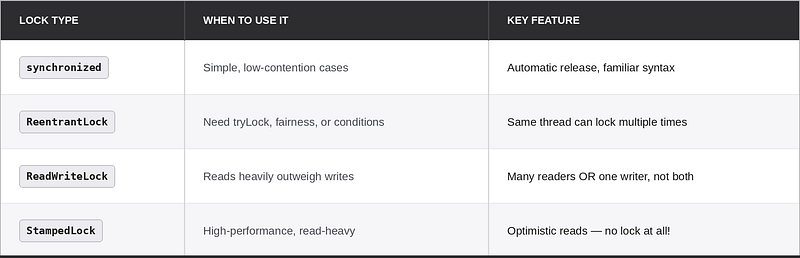
synchronized is simple but limited. java.util.concurrent.locks gives you more power: try to acquire without blocking, set timeouts, choose fairness policy, and separate read from write access.
ReentrantLock lock = new ReentrantLock();      // default: non-fair
ReentrantLock fairLock = new ReentrantLock(true); // threads served in order

// Always unlock in finally!
lock.lock();
try {
    doWork();
} finally {
    lock.unlock();
}

// tryLock - non-blocking. Perfect for avoiding deadlocks
if (lock.tryLock(100, TimeUnit.MILLISECONDS)) {
    try { doWork(); }
    finally { lock.unlock(); }
} else {
    System.out.println("Couldn't get the lock - moving on");
}

// ReadWriteLock - readers don't block each other
ReadWriteLock rwLock = new ReentrantReadWriteLock();
void read() {
    rwLock.readLock().lock();  // many threads can read simultaneously
    try { /* read */ }
    finally { rwLock.readLock().unlock(); }
}

void write(String val) {
    rwLock.writeLock().lock(); // exclusive - blocks all readers too
    try { /* write */ }
    finally { rwLock.writeLock().unlock(); }
}
Lock Conditions — upgrade your wait/notify
Conditions are wait()/notify() but tied to a specific ReentrantLock. The big win: you can have multiple conditions per lock — wake only the producers, or only the consumers, not everyone.
Lock Conditions — targeted wake-up
ReentrantLock lock = new ReentrantLock();
Condition notFull  = lock.newCondition(); // producers wait here
Condition notEmpty = lock.newCondition(); // consumers wait here
Queue<String> buffer = new LinkedList<>();
int capacity = 10;

void produce(String item) throws InterruptedException {
    lock.lock();
    try {
        while (buffer.size() == capacity) notFull.await();
        buffer.add(item);
        notEmpty.signal(); // wake ONE consumer, not everyone
    } finally { lock.unlock(); }
}

String consume() throws InterruptedException {
    lock.lock();
    try {
        while (buffer.isEmpty()) notEmpty.await();
        String item = buffer.poll();
        notFull.signal(); // wake ONE producer
        return item;
    } finally { lock.unlock(); }
}
Volatile — the visibility keyword
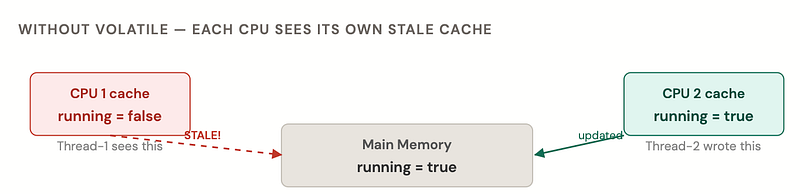
Without volatile, threads can cache variables in CPU registers and never see updates made by other threads. volatile tells the JVM: “always read this from and write this to main memory.”
class Worker implements Runnable {
    private volatile boolean running = true; // always read from main memory

    public void run() {
        while (running) {
            doWork();
        }
        System.out.println("Stopped!");
    }

    public void stop() {
        running = false; // visible to all threads immediately
    }
}

// volatile also prevents instruction reordering across the write
// Useful for the "double-checked locking" singleton pattern:
class Singleton {
    private static volatile Singleton instance;
    public static Singleton getInstance() {
        if (instance == null) {
            synchronized (Singleton.class) {
                if (instance == null) {
                    instance = new Singleton(); // volatile needed here
                }
            }
        }
        return instance;
    }
}
VOLATILE ≠ ATOMIC
volatile int count; count++;is still NOT thread-safe. Increment is three operations (read, add, write). UseAtomicIntegerinstead.volatileonly guarantees visibility, not compound atomicity.
Atomic variables, CAS & CPU cache
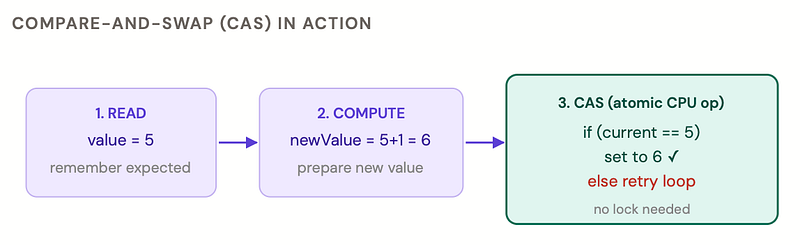
java.util.concurrent.atomic classes use Compare-And-Swap (CAS) — a single CPU instruction. It checks if a value is what you expect; if yes, swaps it atomically. If no (another thread changed it), it retries. No locks. No blocking. Very fast.
AtomicInteger counter = new AtomicInteger(0);
counter.incrementAndGet();         // returns new value (++count)
counter.getAndIncrement();         // returns old value (count++)
counter.addAndGet(5);             // counter += 5
counter.compareAndSet(5, 10);    // if 5, set to 10 - returns true/false

// AtomicReference for any object
AtomicReference<String> ref = new AtomicReference<>("old");
ref.compareAndSet("old", "new"); // thread-safe swap

// LongAdder - faster than AtomicLong under HIGH contention
// Uses multiple cells internally to reduce CAS collisions
LongAdder adder = new LongAdder();
adder.increment();
adder.add(42L);
long total = adder.sum(); // slightly eventual - sums all cells

// AtomicStampedReference - fixes the ABA problem
// (value changes A→B→A; CAS wrongly thinks nothing changed)
AtomicStampedReference<String> stamped =
    new AtomicStampedReference<>("A", 0);
stamped.compareAndSet("A", "B", 0, 1); // must match stamp too
Daemon threads
A daemon thread is a background thread that the JVM will kill as soon as all non-daemon (user) threads finish. It doesn’t prevent the JVM from exiting. Think: garbage collector, log flusher, heartbeat pinger.
User thread (default)
JVM waits for it to finish. Use for your app’s main work — processing requests, writing to DB, etc.
Daemon thread
JVM kills it abruptly when all user threads exit. Use for background housekeeping that should NOT block shutdown.
Thread heartbeat = new Thread(() -> {
    while (true) {
        sendPing();
        Thread.sleep(5000);
    }
});

heartbeat.setDaemon(true); // MUST be set before start()!
heartbeat.start();
// When main thread ends → JVM exits → heartbeat is killed
// No waiting, no graceful shutdown, just poof
// Check if a thread is daemon:
boolean isDaemon = heartbeat.isDaemon(); // true
DON’T DO I/O IN DAEMON THREADS
Daemon threads get killed mid-operation — no finally blocks, no cleanup. Never do database writes, file flushes, or any state-critical work in a daemon thread. It will be cut off without warning.
ExecutorService & Future
Creating raw threads is wasteful — each costs ~1MB of stack. ExecutorService manages a pool of reusable threads. You submit tasks; it runs them. Done.
Callable is like Runnable but it can return a value and throw checked exceptions. Submitting a Callable gives you a Future — a promise for the result.
ExecutorService pool = Executors.newFixedThreadPool(4);

// Submit a Callable - returns a Future
Future<String> future = pool.submit(() -> {
    Thread.sleep(1000);
    return "Data from DB"; // can return values!
});
System.out.println("Doing other stuff while DB query runs...");

// get() blocks until done - or throws on error/timeout
String result = future.get(5, TimeUnit.SECONDS);
System.out.println(result);

// invokeAll - submit a batch, wait for ALL
List<Callable<Integer>> tasks = List.of(
    () -> computeA(),
    () -> computeB(),
    () -> computeC()
);
List<Future<Integer>> results = pool.invokeAll(tasks, 10, TimeUnit.SECONDS);

// invokeAny - return first result, cancel the rest (hedged requests!)
Integer fastest = pool.invokeAny(tasks);

// Always shut down! An ExecutorService keeps the JVM alive
pool.shutdown();
if (!pool.awaitTermination(30, TimeUnit.SECONDS)) {
    pool.shutdownNow();
}
Thread Pool types
Java gives you factory methods for common pool configurations. In production, you’ll often configure ThreadPoolExecutor directly to know exactly what you’re running on.
newFixedThreadPool(n)
N threads, unlimited queue. Good for CPU-bound work. Risk: queue grows unbounded under sustained load.
newCachedThreadPool()
Unlimited threads, 60s idle timeout. Good for bursty short tasks. Danger: thread explosion under sustained load.
newSingleThreadExecutor()
One thread, sequential. Like a lock-free serial queue. Great for ordered processing.
newScheduledThreadPool(n)
Delay and periodic tasks. Replacement for Timer— one exception won’t kill future runs.
ThreadPoolExecutor executor = new ThreadPoolExecutor(
    4,                                      // corePoolSize — always-alive threads
    16,                                     // maxPoolSize — burst capacity
    60L, TimeUnit.SECONDS,                  // idle thread keepalive
    new LinkedBlockingQueue<>(200),        // bounded queue — prevents OOM
    r -> {
        Thread t = new Thread(r, "api-worker-" + counter.incrementAndGet());
        t.setDaemon(true);
        return t;
    },
    new ThreadPoolExecutor.CallerRunsPolicy() // backpressure: caller runs it
);

// Rejection policies when queue is full:
// AbortPolicy      → throws RejectedExecutionException (default)
// CallerRunsPolicy → caller thread executes the task (natural throttle)
// DiscardPolicy    → silently drops the task (risky!)
// DiscardOldestPolicy → drops the oldest queued task and retries
// Monitor your pool in production:
executor.getActiveCount();         // threads currently working
executor.getQueue().size();        // tasks waiting - this growing = bottleneck!
executor.getCompletedTaskCount();  // total completed tasks
ForkJoinPool & recursive tasks
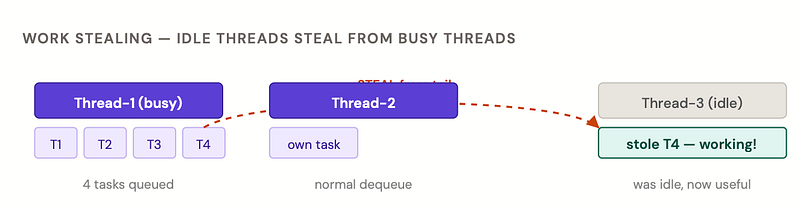
Regular thread pools are bad at recursive divide-and-conquer: a thread splits a task into subtasks and then blocks waiting for them — wasting a thread. ForkJoinPool uses work stealing: idle threads steal subtasks from busy threads’ queues. Nobody sits idle.
import java.util.concurrent.*;

class SumTask extends RecursiveTask<Long> {
    private final int[] data;
    private final int from, to;
    static final int THRESHOLD = 1000; // split until chunk is small enough
    SumTask(int[] data, int from, int to) {
        this.data = data; this.from = from; this.to = to;
    }
    protected Long compute() {
        if (to - from <= THRESHOLD) {
            long sum = 0;
            for (int i = from; i < to; i++) sum += data[i];
            return sum;
        }
        int mid = (from + to) / 2;
        SumTask left = new SumTask(data, from, mid);
        SumTask right = new SumTask(data, mid, to);
        left.fork();              // push left to thread pool
        long rightResult = right.compute(); // run right inline
        return left.join() + rightResult;   // join left result
    }
}
ForkJoinPool fjp = ForkJoinPool.commonPool(); // shared JVM-wide pool
long total = fjp.invoke(new SumTask(bigArray, 0, bigArray.length));
// RecursiveAction for void tasks (no return value)
CountDownLatch
A CountDownLatch is a one-time gate. You initialize it with a count. Threads call countDown() to decrement it. Anyone waiting on await() is released when it hits zero. Think of it as a race starting pistol — or waiting for all microservices to warm up before accepting traffic.
int workerCount = 5;
CountDownLatch latch = new CountDownLatch(workerCount);
ExecutorService pool = Executors.newFixedThreadPool(workerCount);

for (int i = 0; i < workerCount; i++) {
    final int id = i;
    pool.submit(() -> {
        try {
            processChunk(id);
        } finally {
            latch.countDown(); // ALWAYS in finally - even on exception
        }
    });
}
latch.await();        // main thread blocks here
// latch.await(10, TimeUnit.SECONDS); // or with timeout
System.out.println("All chunks processed!");
// Starting gun pattern - release all threads simultaneously
CountDownLatch startGun = new CountDownLatch(1);
for (int i = 0; i < 10; i++) {
    new Thread(() -> {
        startGun.await(); // all 10 threads wait here
        runBenchmark();
    }).start();
}
startGun.countDown(); // fires - all 10 released at the same instant
Semaphore
A Semaphore controls access to a limited pool of resources. Think: connection pool with N connections, or a rate limiter that caps concurrent requests. It maintains a count of permits. Threads acquire permits; if none are available, they block. When done, they release.
// Only 3 DB connections available
Semaphore dbPool = new Semaphore(3);
void queryDatabase() throws InterruptedException {
    dbPool.acquire();   // blocks if all 3 permits are taken
    try {
        runQuery();
    } finally {
        dbPool.release(); // always release in finally!
    }
}

// tryAcquire - non-blocking version
if (dbPool.tryAcquire(500, TimeUnit.MILLISECONDS)) {
    try { runQuery(); }
    finally { dbPool.release(); }
} else {
    returnCachedResult(); // graceful fallback
}

// Semaphore(1) = mutex (similar to synchronized, but acquirable across methods)
Semaphore mutex = new Semaphore(1);

// Fair semaphore - threads served in arrival order (no starvation)
Semaphore fair = new Semaphore(5, true);
CopyOnWrite collections
CopyOnWriteArrayList and CopyOnWriteArraySet trade write performance for read performance. Every write creates a fresh copy of the underlying array. Readers always see a consistent snapshot. Zero locking on reads.
Perfect for…
Event listener lists. Configuration snapshots. Anything read many times, updated rarely (like once per deployment).
Terrible for…
Large collections with frequent writes. Every add/remove copies the entire array — O(n) memory allocation per write.
CopyOnWriteArrayList<EventListener> listeners = new CopyOnWriteArrayList<>();

// Write - creates a new internal array, old readers unaffected
listeners.add(myListener);
listeners.remove(oldListener);

// Read - snapshot, safe without any locking
// Iterating CopyOnWriteArrayList never throws ConcurrentModificationException
for (EventListener l : listeners) {
    l.onEvent(event); // concurrent add/remove won't break this loop
}

// Regular ArrayList under the same scenario would need:
List<EventListener> synced = Collections.synchronizedList(new ArrayList<>());
synchronized (synced) { // must manually sync iteration!
    for (EventListener l : synced) l.onEvent(event);
}
ThreadLocal
ThreadLocal gives each thread its own isolated copy of a variable. No sharing, no synchronization needed. Classic uses: per-request user context, database connection per thread, or formatters (which aren’t thread-safe).
// Static ThreadLocal — each thread gets its own value
static ThreadLocal<User> currentUser = new ThreadLocal<>();

// Set at the start of a request (e.g. in a filter/interceptor)
currentUser.set(authenticatedUser);

// Anywhere deep in the call stack - no need to pass the user around
User user = currentUser.get();

// CRITICAL: always clean up! Thread pools reuse threads.
// Old value from a previous request will leak to the next!
try {
    currentUser.set(user);
    handleRequest();
} finally {
    currentUser.remove(); // prevents memory leaks in thread pools
}

// ThreadLocal with default value
ThreadLocal<SimpleDateFormat> formatter =
    ThreadLocal.withInitial(() -> new SimpleDateFormat("yyyy-MM-dd"));

// InheritableThreadLocal - child threads inherit parent's value
InheritableThreadLocal<String> traceId = new InheritableThreadLocal<>();
traceId.set("req-abc-123");
new Thread(() -> System.out.println(traceId.get())).start(); // "req-abc-123"
MEMORY LEAK TRAP
In a thread pool, threads are reused indefinitely. If you set a
ThreadLocaland never callremove(), the value stays attached to that thread forever — causing memory leaks and data leaking between requests. Always clean up in afinallyblock.
Virtual Threads (Java 21)
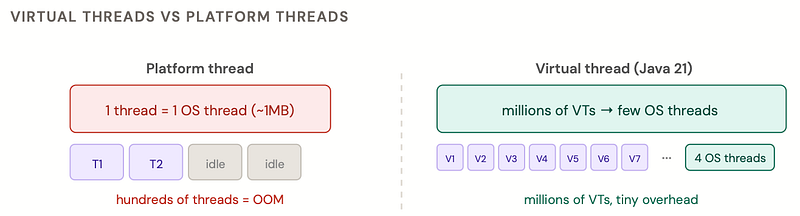
Traditional platform threads map 1:1 to OS threads. 1 MB stack. ~10,000 max before things get painful. Virtual threads are JVM-managed — lightweight, cheap to create by the million. When a virtual thread blocks (I/O, sleep, lock), the JVM unmounts it from the carrier OS thread and parks it. The carrier is free to run another virtual thread. Magic.
// Create a single virtual thread
Thread vt = Thread.ofVirtual().name("my-vt").start(() -> handleRequest());

// Virtual thread per task - executor backed by virtual threads
try (ExecutorService executor = Executors.newVirtualThreadPerTaskExecutor()) {
    for (Request req : incoming) {
        executor.submit(() -> handle(req)); // each gets a new virtual thread
    }
} // auto-shutdown on close

// Blocking I/O is now FINE - JVM unmounts the virtual thread while waiting
// No need for reactive/async code just to avoid blocking
// Check if a thread is virtual:

Thread.currentThread().isVirtual(); // true
// What NOT to do with virtual threads:
// 1. Don't pin with synchronized + blocking I/O (use ReentrantLock instead)
// 2. Don't use thread pools of virtual threads (defeats the purpose)
// 3. ThreadLocal still works but be careful with large values at scale
WHEN TO USE VIRTUAL THREADS
They shine for I/O-bound, high-concurrency work — HTTP servers, database calls, file reads. They don’t help CPU-bound work (you’re still limited by CPU cores). If you’re using Spring Boot 3.2+, you can enable virtual threads with a single property:
spring.threads.virtual.enabled=true.
ScopedValue (Java 25)
ScopedValue is the modern answer to ThreadLocal. The problems with ThreadLocal: mutable (anyone can change it), inherited unboundedly (leaks to child threads), and requires manual cleanup. ScopedValue is immutable per scope, automatically scoped to a bounded call tree, and works naturally with virtual threads and structured concurrency.
ThreadLocal
Mutable. Lives as long as the thread (or until remove()). Can leak. Doesn’t compose well with virtual threads at scale.
ScopedValue
Immutable within scope. Auto-cleaned when scope exits. No leaks. Designed for virtual threads and structured concurrency.
// Declare a ScopedValue (like a typed key)
static final ScopedValue<User> CURRENT_USER = ScopedValue.newInstance();

// Bind a value for the duration of a lambda
ScopedValue.where(CURRENT_USER, authenticatedUser)
    .run(() -> {
        processRequest();    // can read CURRENT_USER
        callServiceLayer();  // and so can anything it calls
    });

// scope exits → binding is gone. No cleanup needed.
// Read it anywhere inside the scope
void processRequest() {
    User user = CURRENT_USER.get(); // works!
    System.out.println("Processing for: " + user.name());
}

// Re-bind for child scope (doesn't mutate parent)
ScopedValue.where(CURRENT_USER, adminUser)
    .run(() -> {
        User u = CURRENT_USER.get(); // adminUser here
    });

// Back here: CURRENT_USER is still authenticatedUser
// Works great with structured concurrency (Java 21+)
try (var scope = new StructuredTaskScope.ShutdownOnFailure()) {
    scope.fork(() -> callServiceA()); // CURRENT_USER is inherited
    scope.fork(() -> callServiceB()); // automatically - no ThreadLocal tricks
    scope.join().throwIfFailed();
}
STATUS
ScopedValue is finalized in Java 25 (JEP 487). It was in preview since Java 21. If you’re on Java 21–24, add
--enable-previewto use it. It pairs naturally withStructuredTaskScopefor structured concurrency.
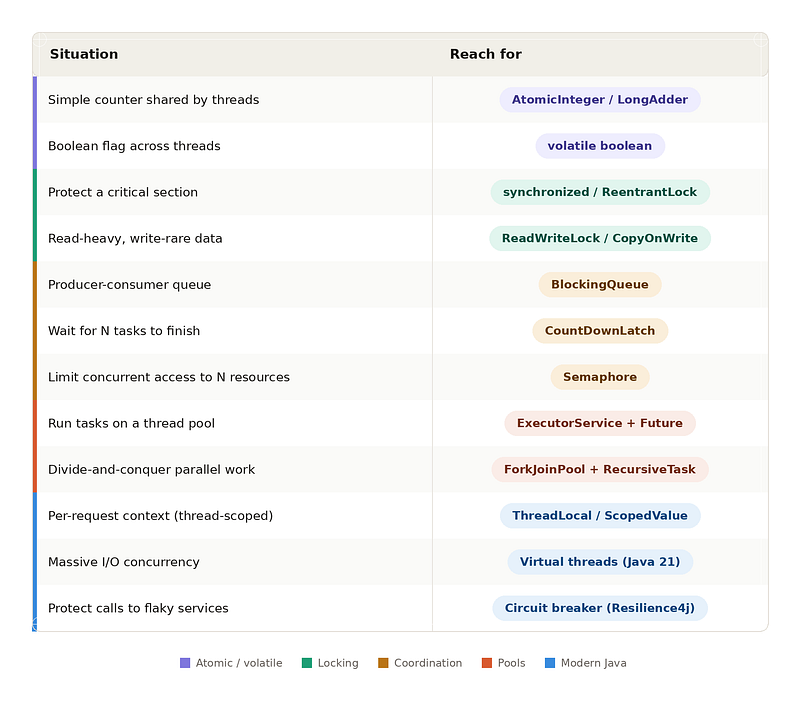
Cheat sheet — pick your tool